Below are some thoughts about the past and present of the web design industry based on my own personal experience. I was spurred to write down my thoughts — however rough they may be — by Simon Collison’s post, This used to be our playground
For several years I have tried to put into words, for my own sake, what working on the web used to be like compared to what it is now. It’s no uncommon topic for people who have been around the web for a while. The typical refrain, to oversimplify it, seems to go something like this: the web used to be fun and expressive, but now it’s business and boring. Again, that’s being reductionist and void of nuance, but I don’t think people would disagree that that at least captures some of the spirit of what we feel.
The best I’ve done at capturing what I think happened in our industry is in the graphic shown below.
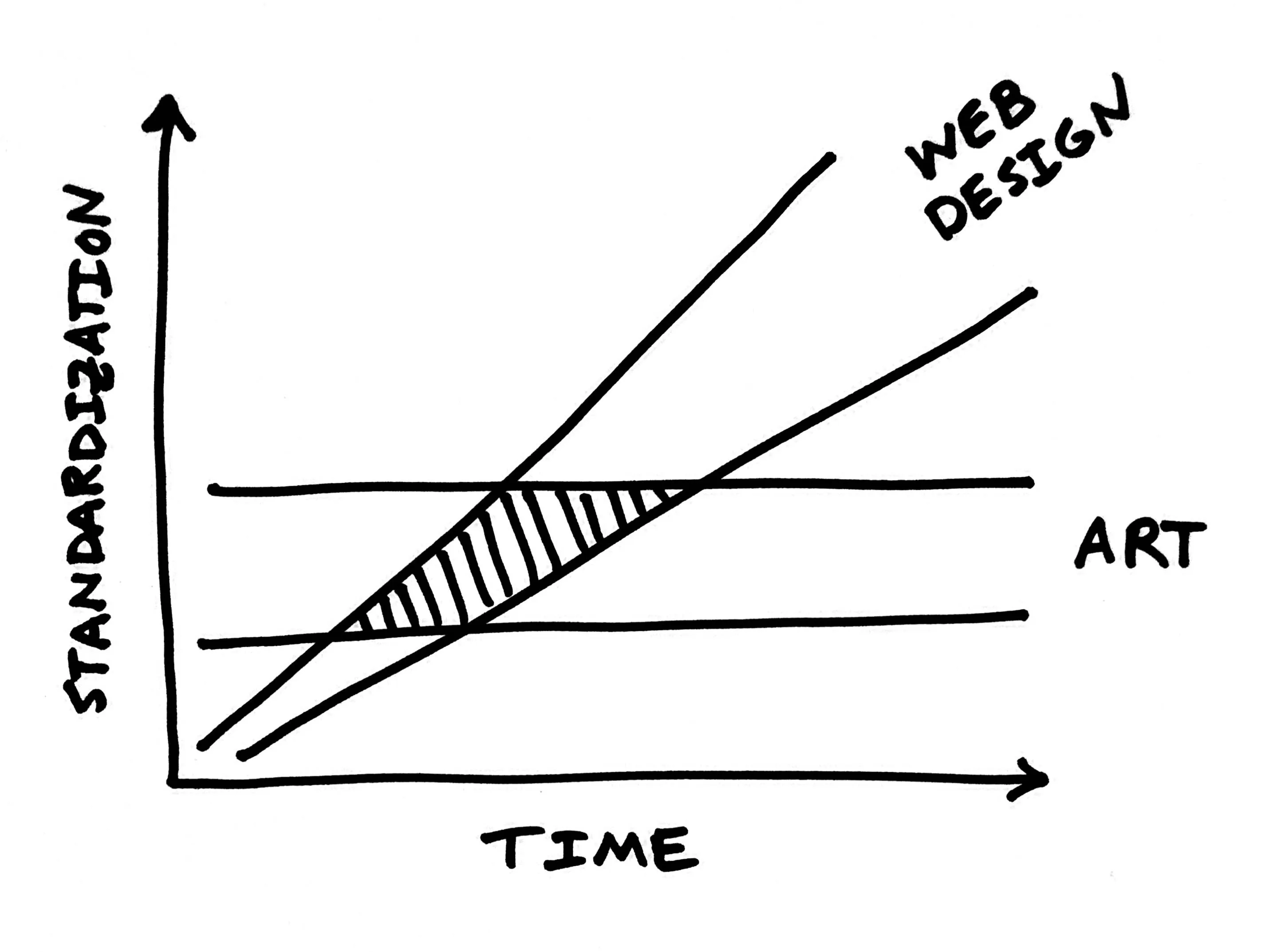
The artist is constant, always moving forward — the first one on the scene who brings energy and experimentation, working through a medium to explore and communicate and express internal feelings and convictions. And I’m using the term “artist” in the generic sense to represent a way of thinking and doing and holding a certain set of preferences. The artist finds freedom in the lack of establishment.
The web design swath, which could represent any trade or profession, follows the way of the world — it grows, becomes more established, more traditional, more solemn, etc. Leadership is handed to business, experimentation and new ideas replaced with standards and best-practices that are further codified the more they are traveled.
The shaded area is the brief period of working on the web where art and industry intermingled in a happy and energetic co-existence. We built and designed sites that were eagerly anticipated and delighted in by other practitioners and enough of the public to where we had the cachet and attention usually reserved for entertainers and authors. We were still introverts and nerds but we were also cool!
This brief moment we had when all eyes seemed to be on our work was an anomaly of a burgeoning industry where the infancy of standards mixed with an ever-growing availability of technology combined with a tectonic cultural shift to produce a zenith of creative experience for the creators.
But this moment is gone and will never return in the same way that it was. The same forces that propelled it quickly tapered it. People now don’t really care about a website redesign because the visual shifts are not so dramatic as before. And their attention is elsewhere anyways. The website is no longer the end in itself.
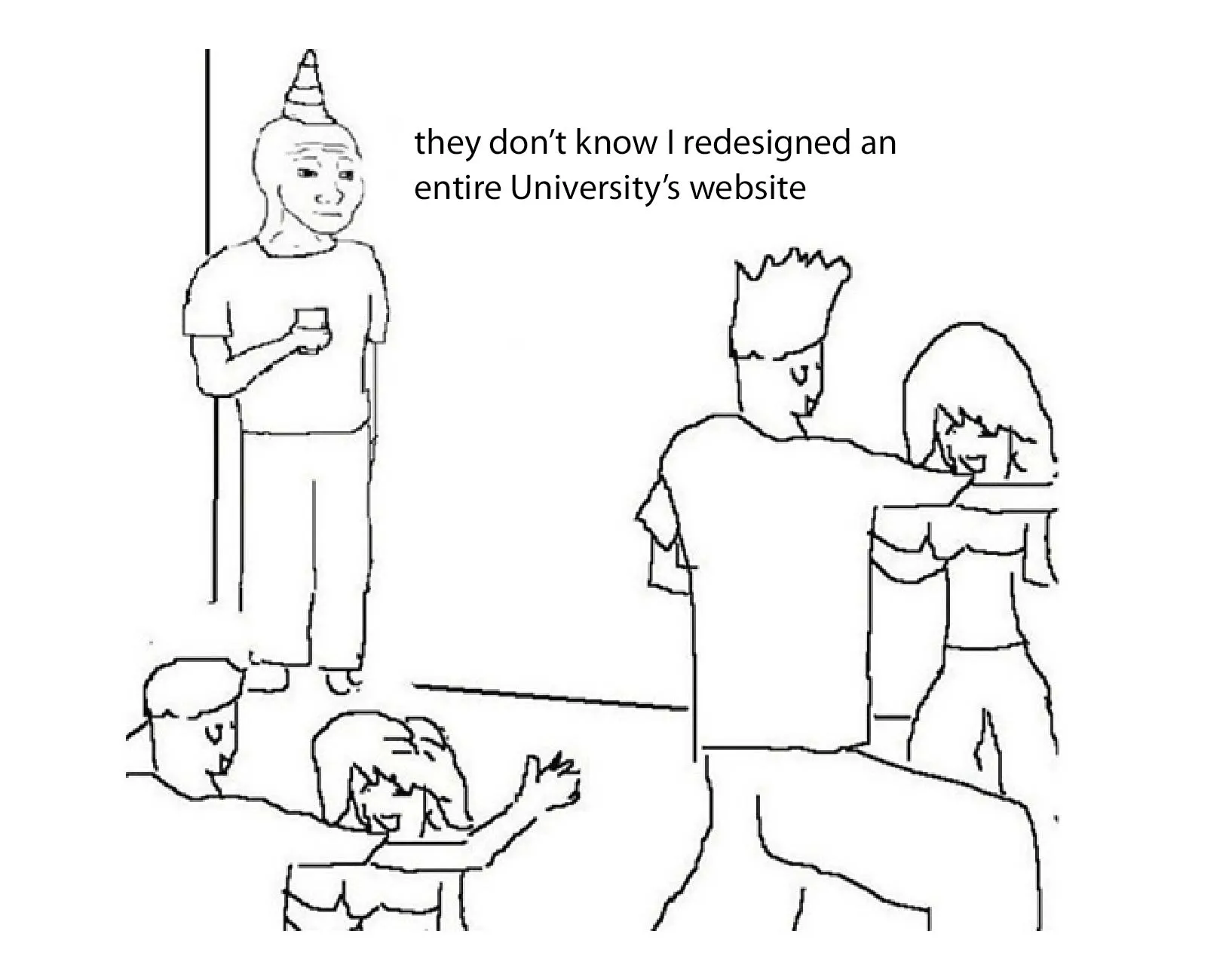
If you’re an artist then you can either adapt or move on to other industries. But to adapt does not have to mean to settle. You can dig deeper into the medium with the same enthusiasm as before. The pattern of the artist can still be realized in the details and the strategy if no longer in the main visual expressions.
The professional
In our now more mature industry, I can with good faith say that I don’t think websites are a vehicle for self-expression. At least not websites made primarily for the public. I see the web as a medium to communicate and facilitate commerce. The more standards we settle on and implement the better the experience for the person using the website.
The book is a good analogy. Every book has the same basic experience and the reader has a certain expectation for the book even if they don’t know how to articulate it — standard measure, readable typeface, appropriate font size and leading. But of course each book is also completely different — the size, the choice of typeface, the style of headings, the book cover, etc. Each book is its own unique experience building off the core established principle of a book. This is the contract between the reader, maker and writer. Or to put it another way — this is the form of the book.
The art, the wildness, the genius, the celebrated, is what comes from the author. The one who fills the book with words. The designer is there to serve the author and the public by facilitating the invisible connection between the two.
With the website, there is a parallel of the designer following an established form for the benefit of all. The public is better off when most websites they interact with have the same underlying, coherent structure. If they can begin to instinctively know where things are, to have macro expectations then we serve them well. There is a way to act within the form that sets apart the hand of the designer without breaking the implicit agreement between those who meet at the website. All websites should have the same form is not an argument for all websites should look the same any more than someone saying all books should be typeset with the same font.
The personal irony of my acceptance of this fact, the advocacy for it even, is that this exact reason was one of the motivations for leaving another field. My education is in civil engineering and I worked for about five years in this industry (mainly as an intern while I was in school) and I loathed how established it all was. There was a manual for everything. But of course this is what you want: all roads should be alike. The excitement comes from what you’re driving, who you’re with, and where you’re going.
The personal
I miss personal websites. My love of seeing websites is why I was never big on RSS; I couldn’t bear reading articles stripped of their author’s style and presented in some monoclonal blob of text; instead I had my websites bookmarked in a group and every morning I would open that group in tabs and look at them one by one. It was a cherished morning ritual. For me the personal website isn’t just an ideal of self-expression, it’s a huge part of my history as a professional.
But I have trouble articulating the reasons and duty for the personal site with the same conviction as I do for the professional. I love them, I have one, and I would encourage anyone who asks to get their own. They are the best place for writing down your thoughts and exploring the design and technical boundaries of the web.
The argument for them is the same argument for why you wouldn’t want Starbucks to be the only coffeeshop in the world. However, I think they will be for a minority. I don’t ever see them being for the majority or making a large imprint on common culture. I would like to be wrong here, but nothing I see in the world makes me think otherwise.
That said, I welcome, encourage, and participate in any attempt to reinvigorate the personal website. I think and instinctively feel that they are important for the web and to abandon or give up the idea would be harmful.
—
I am very open to critique on these ideas! If you have any thoughts or comments please feel free to ping me via email (see footer) or tweet at me: @davidyeiser.